The popular promise versus real metabolic outcomes
The first few mornings can feel oddly “clean”—just coffee, a little edge of hunger, and the sense that you’re finally doing something metabolically powerful. The popular promise is that fewer eating hours automatically means lower insulin, faster fat loss, and steadier glucose. In real life, the results are often less tidy, especially once work meetings, workouts, and late dinners show up.
What tends to separate the success stories from the stalled ones is not the fasting window itself, but what the window changes downstream. If eating is simply compressed, some people end up with fewer total calories and less frequent insulin spikes, and their day-to-day glucose swings may flatten. But if the window leads to bigger “make-up” meals, more evening snacking, or poor sleep from going to bed hungry, stress hormones can rise and appetite signals can get louder, which may push glucose higher the next day. That’s why studies can look contradictory even when they use the same fasting label.
Energy sensing pathways that fasting flips on

By late morning, the hunger can shift from a sharp “I need food” feeling to a flatter, slightly wired steadiness—or, on other days, an unexpected dip where concentrating takes more effort. That inconsistency is often the first clue that the body is moving between fuel systems rather than simply “running out” of energy.
When you stop eating for long enough, insulin exposure usually drops, and the liver begins releasing stored glucose (glycogen) to keep blood sugar steady. As glycogen thins out, the body leans harder on fat breakdown, sending fatty acids into circulation and, in some cases, making more ketones. At the same time, energy-sensing signals inside cells respond to the lower incoming fuel: pathways that favor storage get quieter, while pathways that support fuel mobilization and cellular “maintenance” tend to ramp up. These shifts don’t guarantee better numbers on their own—if the fasting window leads to higher stress hormones, poorer sleep, or rebound eating later, glucose variability and appetite can still worsen even while the “fasted” signals are technically turned on.
What drives the pattern beneath the surface
A week in, the pattern often shows up in small ways: you can make it to noon without thinking about food, then suddenly feel shaky after a hard meeting—or ravenous at 9 p.m. even though you “ate enough.” That mismatch is usually less about willpower and more about how your brain and liver are negotiating predictable fuel versus delayed fuel.
Fasting tends to work best metabolically when it quietly lowers total intake without triggering compensation. But compensation is common: extra-dense meals, more grazing, or “reward” eating after a long stretch of restraint. If protein and resistance training don’t keep pace, some weight loss can come from lean mass, which can soften insulin sensitivity over time even as the scale moves.
When you go to bed hungry or run on coffee, cortisol and adrenaline may rise enough to increase glucose output from the liver, making morning readings feel oddly high. That’s one reason two people can use the same fasting window and get opposite glucose variability.
Intermittent fasting types are not metabolically identical
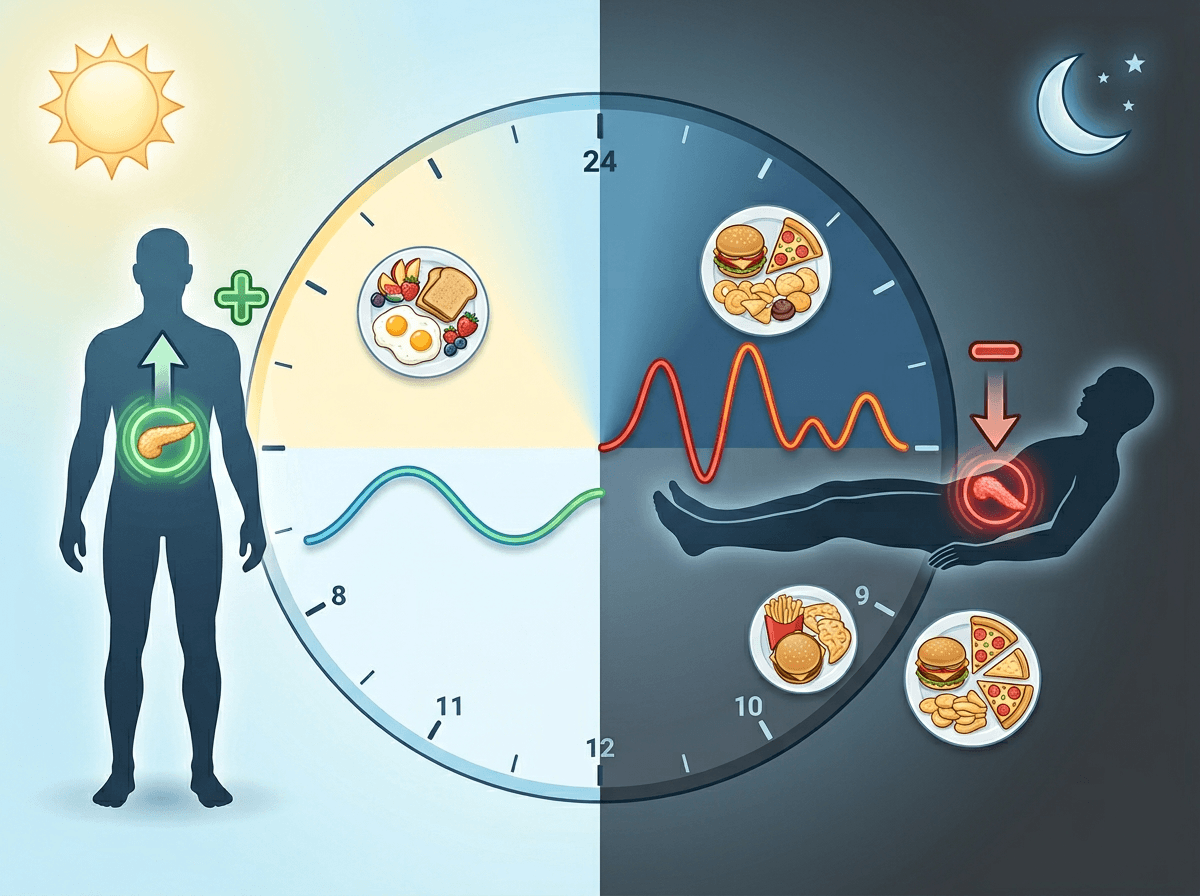
Some people notice the “same” fast feels easy on weekends but messy on workdays—like the window is identical, yet energy and late-night hunger aren’t. That’s often because the label (16:8, 5:2, alternate-day) hides big differences in when glucose and insulin get stressed, not just how long you went without food.
Early time-restricted eating (finishing earlier in the day) may line up better with the body’s circadian pattern, when insulin sensitivity tends to be higher earlier and lower later. A late eating window can still reduce eating occasions, but if it concentrates more calories at night—after coffee, meetings, or a delayed workout—glucose variability can look worse even with fewer “insulin spikes.”
Alternate-day or very low-calorie fast days can create stronger hunger rebound, uneven protein distribution, and more compensation. If your week already has inconsistent sleep or training, that mismatch can matter more than the fasting hours themselves.
What clinical studies show for glucose and lipids
After a few weeks, the first place many people look is the lab panel—expecting the fasting window itself to “show up” as a clear glucose drop. In clinical studies, the signal is usually more modest: time-restricted eating often lowers weight a bit, and glucose markers tend to improve most when total intake drops along with eating occasions. When calorie intake ends up similar, glucose changes can shrink or disappear, even if people swear the fast “felt” effective.
For glucose, trials commonly find small improvements in fasting glucose and insulin resistance measures, with bigger shifts in HbA1c mostly when weight loss is meaningful and consistent. Early time-restricted eating (earlier dinner) sometimes looks better for glucose variability than late windows, which fits the idea that insulin sensitivity is often lower at night—so the same meal can produce a higher excursion.
Triglycerides may trend down with weight loss and less late-night eating, while LDL cholesterol can move either direction depending on fat intake, weight-change pace, and individual response. That mismatch is a big reason two “successful” fasters can get different panels.
When “healthy” fasting backfires unexpectedly
Sometimes the first “red flag” is subtle: you finish a fast feeling proud, then notice your hands are a little shaky or your patience is thin, even before you eat. It can be easy to read that as weak willpower, but in some cases it’s a mismatch between a long gap in intake and a day that still demands steady output—meetings, commuting, training, and caffeine layered on top.
One common backfire pattern is a higher morning glucose number after a “perfect” fast. If sleep gets shorter or dinner gets pushed later and lighter, cortisol and adrenaline may stay elevated and nudge the liver to release more glucose overnight. The fast is real, but the stress response can be real, too—so the meter looks worse even as eating hours shrink.
Another pattern is delayed rebound eating: appetite stays quiet until evening, then ramps up fast, making it harder to hit protein targets and easier to overshoot calories. If this keeps happening, the fasting window may be doing less metabolic “repair” and more schedule-driven strain.
Risk boundaries: medications, life stage, physiology
There’s a particular kind of “off” feeling that matters more than hunger: lightheadedness that doesn’t match your effort, or a shaky, sweaty edge that shows up mid-morning and then vanishes after you eat. In people on glucose-lowering medications—especially insulin or sulfonylureas—longer fasting windows can make those drops more likely, even when the plan looks reasonable on paper. SGLT2 inhibitors add a different uncertainty: fasting plus illness, low-carb eating, or dehydration can sometimes push metabolism toward ketone production in a way that deserves extra caution.
Life stage changes the boundary conditions. For instance, adolescence generally raises the cost of under-fueling, and the “it’s fine, I’ll eat later” logic can backfire. For older adults, the trade-off is often muscle: if fasting makes it harder to distribute protein or support resistance training, metabolic markers can look mixed despite weight loss.
If your window repeatedly triggers binges, insomnia, or weird glucose readings, that pattern is information—not a character test—and it’s a reasonable point to pause and reassess with your clinician.